Letting Facebook off the hook (and Google too)
Hi, this is Tim Wu, taking over for Zephyr with a note on the Facebook case that was dismissed last week. If we are not acquainted, I am a professor at Columbia University and the author of a number of books related to tech and antimonopoly, including The Curse of Bigness. My new book, released just a few weeks ago, is The Age of Extraction, which tells the story of the last 25 years of tech platform power and what needs to be done. You can get it here
*
Last week, as you may have read, a federal district court dismissed the U.S. government’s main anti-monopoly case against Facebook — or Meta, as it calls itself (I’ll use Facebook in this post). The court did so despite strong and direct evidence of monopoly power and wrongful conduct that no one could deny — yet Facebook still managed to get off the hook. The result is that, despite a decade of scandals, whistleblowers, and direct evidence of illegal behavior, no public authority in this country has been able to meaningfully hold Facebook accountable for anything.
Breaking the law has been a winning strategy for Facebook, and the judge’s ruling fortifies the impression that the world’s wealthiest corporations are above the law. It is hard to imagine a worse message for the judiciary to send right now.
The Facebook antitrust case was filed in 2020. The FTC accused the firm of maintaining its monopoly by buying rivals Instagram and WhatsApp in 2012 and 2014 (it also bought other threats). Mark Zuckerberg, in a series of emails later made public, made it clear that he bought the firms to eliminate them as a threat. The antitrust laws may be vague about some things, but buying your most dangerous rivals is supposed to be clearly illegal.
In 2012 and 2014, the FTC, deep in the depths of the antitrust winter, did nothing. Among other things, the agency managed to convince itself that Instagram and Facebook weren’t actually competitors, based on the premise that Instagram was a mobile app and Facebook was mostly (at the time) a desktop app. It takes a lot of education to reach conclusions like this that the average high schooler would find absurd, and by such fine-grained distinctions does the law lose its power.
Under new management and some eight years later, the FTC sued Facebook for monopolization — perhaps seeking, in some way, to correct its mistake. The core of the government’s theory was this: Facebook held a monopoly in personal social networking — sharing with “friends and family.” It continued to hold onto that monopoly to the present day, as demonstrated by its outlandish and durable profits ($87.1 billion in operating profit on $164.5 billion in revenue in 2024, for example). And in 2012 and 2014 it wrongly and intentionally maintained that monopoly with its purchases.
The judge nonetheless let Facebook off the hook by finding it wasn’t a monopoly now (whether it had one in 2012 and 2014 was not discussed, due to a quirk in the law). He then asserted that the development and growth of an adjacent market for short videos such as TikTok and YouTube Shorts since that time shows that Meta does not possess monopoly power. But every firm has its core customers and those who leave for something new: the key question is whether it retains power over its base. Those profits answered the question directly. The judge was forced to twist himself in knots and ignore undergraduate-level economics to give Meta yet another break.
But to dwell on the shortcomings of the judge's reasoning is to overlook something worse: the message that his ruling sends to the country. Among the chief goals of antimonopoly laws like the Sherman Antitrust Act of 1890 — the statute that the government accused Meta of violating — was to make clear who is actually in charge of this country.
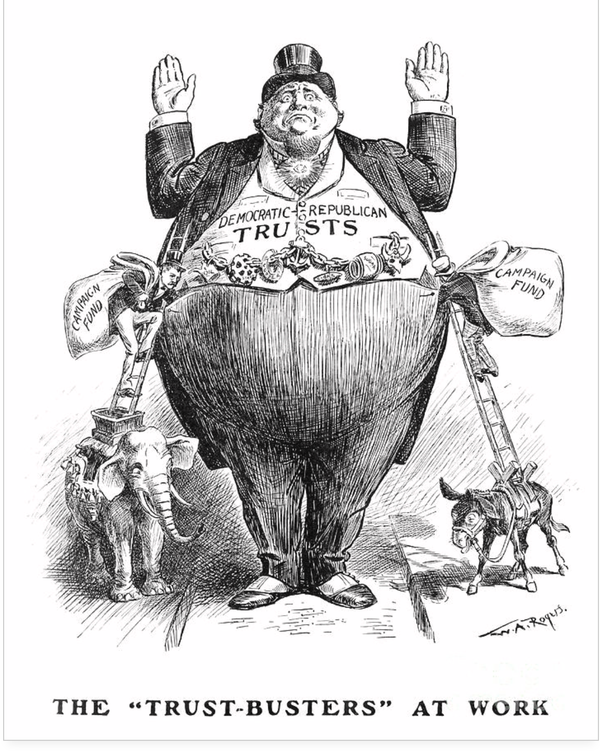
As one of the original anti-monopolists, President Theodore Roosevelt explained in 1901, the antitrust laws are about who is actually in charge of this country. As he put it, the “vital question” is whether “the government has the power to control the trusts.” He understood, during a period characterized by challenges similar to our own, that unaccountable power is a threat to the Republic and that the spectacle of untouchable elites fosters mass resentment.
The misguided ruling in the Facebook case follows the decisions of the federal judge Amit Mehta, who last year did manage to rule that Google is an illegal monopoly — yet this year could not bring himself to impose on Google a strong remedy.
The decisions are the blessing of a major power imbalance of our age. They signal to companies that spending tens of millions of dollars on lawyers will be repaid with billions of dollars in profit.
And maybe the worst part is that they reinforce the tech industry’s cultivated sense of impunity — the belief that they represent an untouchable sovereignty above the control of mere humanity.
Does anyone seriously doubt that Meta is the kind of company that antitrust laws were designed to restrain? In the 1980s and 1990s, judges held AT&T and Microsoft to account for antitrust violations, despite their protests. But there is a faction of the judiciary — often hailing from an earlier, tech-enraptured era — that cannot seem to grasp, unlike seemingly everyone else in the country, that Facebook and Google are precisely the kinds of companies that antitrust law is designed to control.
Unfortunately, the weak antitrust rulings are part of a broader trend. Many of the policies enacted in the 20th century to maintain economic balance have been undermined or gutted: labor law, financial regulation, telecommunications laws, and effective tax laws, among others. For much of the postwar era these laws forestalled a collapse into a two-class society and the resulting class tensions that have upended other republics. As this system of balance collapses, more and more of the population seeks radical responses to its plight.
Back in the 1940s, famed federal judge Learned Hand pondered a similar case against the Alcoa company, which dominated the aluminum market in the United States. It was in some ways a tough case, and the district court had ruled against the government. Hand granted that there were “legal niceties” in which one might get “entangled.” But he concluded that “if we hold that it is not a monopoly,” everyone not caught up in those niceties would “quite rightly, I think, write us down as asses.”
There are times when the judiciary needs, like Learned Hand, to realize the broader stakes. Our judiciary — and Congress too, for that matter — is failing to rise to the challenges of our time. Both are showing themselves to be out of touch with economic realities that any American could describe. It is no wonder the population is growing increasingly cynical — and more and more ready to look to ideologies that promise to upend the entire system.
(A shorter version of this note appeared in the New York Times, as The Bad Reasoning in the Meta Antitrust Ruling Isn’t Even the Worst Part
Thanks for reading,
Tim